Prepared learning, not inherited recollection
Can Monkeys Inherit Fear of Snakes?
By The Konshus Team
The short answer
The classic monkey experiments suggest that monkeys can be prepared to learn fear of snakes more readily than fear of harmless objects. They do not show that a monkey inherits an ancestor’s memory of encountering a snake.
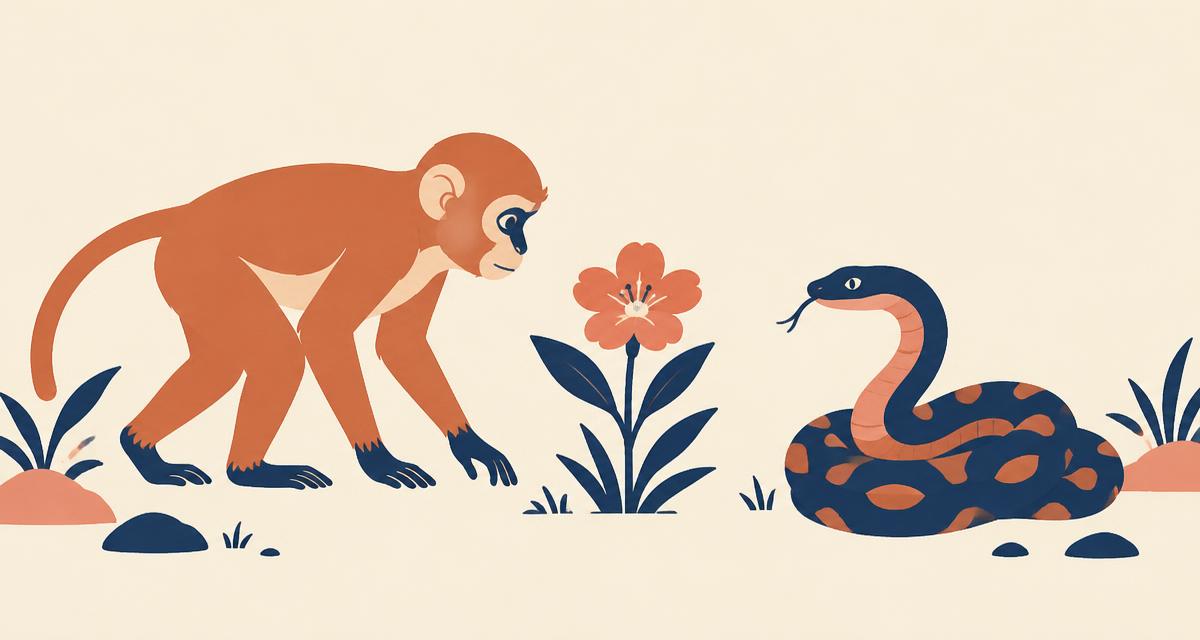
Picture a young rhesus monkey raised in a laboratory, with no previous snake encounter. It knows its surroundings and social companions, but it has no personal experience connecting snakes with danger. Now it watches another monkey react fearfully to a snake. The observer can learn a fear response without suffering a bite or meeting a snake in the wild.
That sounds like ordinary learning from someone else. The intriguing question is whether the same demonstration would work just as well with a flower. Researchers used that contrast to investigate a deeper possibility: perhaps a learner arrives with some associations easier to acquire than others. A head start in learning, however, is not the same thing as a memory passed down through generations.
What did the monkey experiments actually show?
Susan Mineka and colleagues studied observational learning of snake fear in laboratory-reared rhesus monkeys. Later work by Michael Cook and Mineka compared learning about threatening animals with learning about harmless objects. Rather than assuming that every observed fear would transfer equally, the researchers made the object of the demonstration part of the test.
In an edited-video design, model monkeys appeared to react fearfully to toy snakes or crocodiles, or to flowers or toy rabbits. The observers readily acquired fear of the threat-relevant animals. They did not acquire a comparable fear of the innocuous objects. The same general route to learning—watching a model—produced different results depending on what the apparent danger was.
That contrast matters more than a demonstration of imitation alone. It suggests selective learning: some associations were more readily acquired in this task. It does not establish that every monkey automatically fears snakes, or that an observer carries a stored account of an ancestor’s snake encounter. The evidence concerns how a new lesson is learned, not the transfer of an old personal recollection.
How is prepared learning different from an inborn fear?
An innate response is a built-in pattern of response or sensitivity. Prepared learning is a bias that makes some associations easier to acquire through experience. Social learning describes how information reaches the learner: through observation, communication, or teaching rather than direct exposure to the original event. These mechanisms can sound similar in everyday conversation, but they answer different questions.
If fear were entirely present before observation, watching another monkey would not be needed to teach it. If every association were equally easy to learn, flowers should be more interchangeable with snakes in the demonstration. The selective results instead suggest that a learning system may be especially receptive to particular lessons. No single experiment settles every contribution of genes, development, and environment.
Psychologist Martin Seligman’s account of evolutionary preparedness helps explain why that might happen. Imagine an environment where overlooking a venomous snake is costly but a false alarm is relatively cheap. A tendency to notice snake-like forms or learn danger associations quickly could be advantageous. This is an evolutionary explanation, not proof of a universal, dedicated snake-fear mechanism. The proposed advantage belongs to a learning bias, not an inherited story.
Are human babies born afraid of snakes?
Infant findings make the distinction between attention and fear especially important. In a 2009 study, Judy DeLoache and Vanessa LoBue found that infants did not spontaneously respond differently to moving snakes and other animals in one test. In another, infants looked longer at snake videos paired with a frightened voice than at snake videos paired with a happy voice.
Those findings suggested a readiness to connect snakes with fear, rather than demonstrating that fear was already present at birth. In 2010, LoBue and DeLoache reported that eight- to fourteen-month-old infants responded more rapidly to snake pictures than flower pictures, and to angry faces than happy faces, in their detection tasks.
A quicker response is not a direct measure of terror. Something can capture a baby’s attention without being understood as dangerous. Reviews of infancy research caution against turning heightened attention to snakes and spiders into a sweeping claim that babies are born afraid of them. What a learner notices, what it learns, and what it fears need to remain separate questions.
Do mouse studies show that memories can be inherited?
A different line of research asks whether a parental experience can affect descendants biologically. Brian Dias and Kerry Ressler reported that male mice conditioned before conception to associate the odor acetophenone with an aversive experience produced offspring with increased sensitivity to that odor. They also reported changes in the relevant olfactory pathway and effects extending to a second generation.
Cross-fostering and reproductive manipulations produced findings consistent with biological transmission. But increased odor sensitivity is not evidence that descendants remembered the conditioning sessions. The reported measures involved behavior, sensitivity, neural anatomy, and molecular markers—not an inherited recollection of what happened to a parent.
The broader interpretation remains debated. Germ cells and early embryos undergo substantial epigenetic reprogramming, complicating explanations of how experience-related marks might persist. Reviews stress the importance of distinguishing direct exposure from persistence in later, unexposed generations, while ruling out genetic and environmental alternatives. These findings do not establish that humans inherit ancestors’ particular fears or autobiographical experiences. A biological influence on later behavior is a narrower claim than a memory traveling between generations.
What can travel between learners without becoming a memory?
Social learning offers a less mysterious way for experience to influence someone who never lived through it. An animal can learn from another animal’s avoidance. A child can learn to check a road by watching a parent. A student can learn about a bridge failure from an engineer’s account. The original event need not happen again for its lesson to be useful.
Yet the lesson and its source remain distinct. An observer can be mistaken, an account can omit information, and a warning can exaggerate a danger. Learning from a report does not make the reported experience the learner’s own. That distinction protects us from treating useful secondhand knowledge as firsthand evidence.
The monkey findings are compelling without an inherited-memory explanation. They suggest that learning need not begin from equal readiness for every possible association. The learner may arrive with a starting bias, then acquire a particular response through observation. The careful conclusion is not that a monkey remembers a snake it never encountered. It is that the monkey may be especially ready to learn a lesson about one.
In one sentence
- Prepared learning
- Prepared learning is a bias toward noticing or learning some associations more readily than others.
- Social learning
- Social learning is acquiring a lesson through observation, communication, or teaching rather than directly undergoing the original event.
- Personal memory
- A personal memory is a record or recollection grounded in an individual’s own experience and its subsequent encoding.
Key takeaways
- Rhesus monkeys learned observed fear more readily for threat-relevant animals than for harmless objects in these tasks.
- Prepared learning is a bias in acquiring an association, not an inherited recollection.
- Infant attention to snakes should not automatically be interpreted as fear.
- Reported effects in mouse descendants do not demonstrate inherited memories of parental experiences.