A warning without a remembered experience
Can worms inherit memories?
By The Konshus Team
The short answer
Some experiments suggest that worms can inherit a tendency to avoid a pathogen their ancestors encountered, rather than a conscious memory of that encounter. The original researchers reported persistence through four generations, but replication studies have disagreed about how reliably the effect lasts that long.
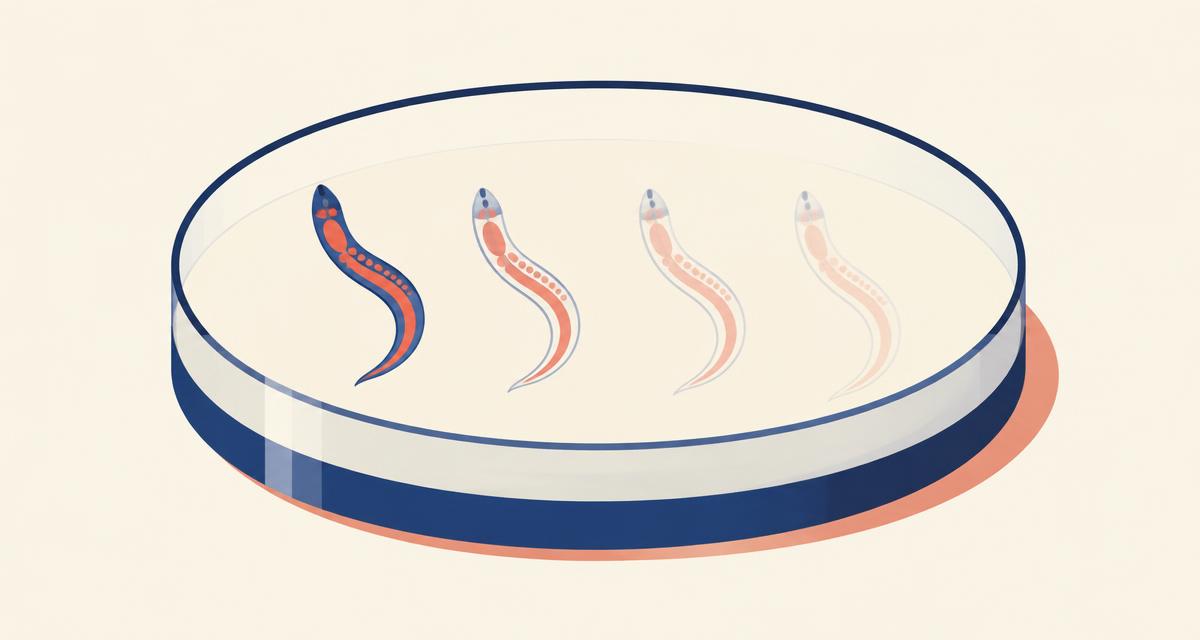
Imagine facing two meals with no way to ask which one is safe. One is ordinary food; the other looks appealing but can make you ill. For the tiny worm Caenorhabditis elegans, that choice can involve two patches of bacteria. Experience can change its preference: after enough exposure to a dangerous strain, the worm learns to avoid it.
The more surprising question is whether its descendants can begin life with a similar warning, despite never receiving the same training. Several experiments suggest they can. Yet the phrase inherited memory needs careful handling. A changed starting preference is not the same as replaying an ancestor’s experience, and scientists have not agreed on every boundary of the effect. The uncertainty makes this a more useful story, not a less interesting one.
What did the original worm experiment find?
In a 2019 Cell study, Rebecca Moore, Rachel Kaletsky, and Coleen Murphy examined avoidance of Pseudomonas aeruginosa PA14. Untrained worms can prefer this pathogenic bacterium over their usual laboratory food, Escherichia coli OP50. Following sufficient exposure, however, they change their behavior and avoid PA14. The researchers then tested descendants that had not deliberately been trained on the pathogen.
The team reported avoidance through four generations of untrained descendants. In the family-tree notation used for these experiments, the trained parent is P0, its children are F1, and its great-great-grandchildren are F4. The original group reported that the response faded in F5. That distinction matters: four generations describes a particular reported pattern, not a universal duration for inherited behavior.
There is also a reason to look beyond the first generation. Embryos can be affected by a parent’s exposure, so a response in children does not settle the question of transmission across more distant generations. Following the behavior further helps researchers ask whether a signal has traveled through the reproductive lineage rather than merely affected offspring during parental exposure.
Does inherited avoidance count as a memory?
It depends on what memory means. These experiments measured a behavioral tendency: whether worms approached or avoided a bacterial food source. They did not reveal an internal picture of an ancestor becoming sick. Nothing in the findings demonstrates conscious recollection or a humanlike autobiographical memory. A descendant can behave differently because of the past without mentally revisiting that past.
The relevant biological idea is transgenerational epigenetic inheritance. Here, epigenetic refers to effects involving gene regulation and related molecular pathways without requiring a change in the underlying DNA sequence. It does not mean that any experience can become a permanent hereditary instruction. The claim is narrower: particular environmental encounters may influence descendants under particular experimental conditions.
Keeping those meanings separate prevents an appealing headline from swallowing the result. Continuity of DNA, continuity of behavior, and continuity of someone’s remembered experience are different things. The worm research concerns the second of these, with experiments investigating molecular pathways that might support it. It does not establish the third, either in worms or in people.
How could bacteria leave a transferable warning?
A 2020 Nature study by Kaletsky and colleagues investigated a possible molecular trigger. In their experiments, exposure to purified small RNAs from the pathogenic bacteria was enough to produce avoidance in treated worms and later generations. The animals did not need the full infection for this small-RNA-induced response. That finding shifted attention from an illness alone to information carried by a bacterial molecule.
The researchers identified a bacterial RNA called P11. In their experimental system, it was both necessary and sufficient for the small-RNA-induced response. P11 had sequence complementarity to the worm gene maco-1, which participated in the mechanism. The study also implicated RNA-interference machinery, the reproductive germline, and particular sensory neurons. These are components of a biological pathway, not a miniature account of an ancestor’s life.
The earlier 2019 work found that PRG-1, a protein in a Piwi/Argonaute small-RNA pathway, was required for the reported transgenerational response. Changes involving DAF-7 signaling in ASI sensory neurons accompanied the behavior. Together, the studies suggest a division of labor: environmental signals are processed through molecular pathways, and later animals express a changed behavioral response.
Why might an inherited warning disappear?
A warning is useful only while it fits the environment. A dangerous bacterium may disappear, while a related organism may be harmless or beneficial. An inherited avoidance response could therefore protect descendants in one setting and cost them food in another. Persistence is not automatically better than forgetting.
In 2024, Titas Sengupta and colleagues studied another pathogen, Pseudomonas vranovensis, obtained from the worms’ natural microbial environment. They identified a small RNA called Pv1 that could drive learned avoidance in their experiments. They again reported transmission through four generations, with the response absent by the fifth. But the warning also led worms to avoid a beneficial species, Pseudomonas mendocina.
That unwanted avoidance offers a possible explanation for a limited duration. If an inherited alarm rejects good food as well as danger, eventually resetting it could be advantageous. The researchers proposed that such costs might favor a response that does not persist indefinitely. This remains an evolutionary hypothesis, not proof that nature deliberately installed a four-generation timer. The observation and the proposed explanation should remain separate.
Have other laboratories reproduced the result?
The replication record is mixed. In a 2025 eLife study, Gainey, Shubin, and Hunter found evidence of avoidance in exposed worms and their first-generation descendants. Despite testing different conditions, they did not consistently reproduce persistence beyond F1. They concluded that the reported multigenerational PA14 response was not robust under the conditions they examined.
Kaletsky and colleagues disputed that interpretation in a 2025 response. They argued that bacterial growth conditions affect production of the P11 trigger. They also emphasized the choice assay: without a paralytic to hold worms where they first choose a food source, animals may change preference during the test. Under that account, both preparation and measurement can affect what the experiment detects.
A separate 2025 study led by Aalimah Akinosho reported avoidance through F1 and F2 using carefully controlled conditions, with weaker effects in descendants than in trained parents. The eLife assessment described that independent evidence as solid. Reproduction through F2 supports a multigenerational effect under those conditions, but it does not independently establish every detail of the original F4 finding.
What is the most careful conclusion?
The strongest summary keeps the result and its limits together. Worms can learn to avoid pathogenic bacteria. Several studies implicate small-RNA pathways, and some laboratories report avoidance in descendants that were not deliberately trained. An independent group reproduced persistence through F2. How reliably the full four-generation pattern appears across laboratories, bacterial strains, and assays remains contested.
These findings do not show that worms convert a learned decision into a new DNA sequence. They do not overturn evolutionary biology or demonstrate that people inherit their ancestors’ personal recollections. Instead, they suggest that certain experiences can influence molecular states or signals that affect later generations for a limited time.
Perhaps the most revealing detail is the beneficial bacterium that gets avoided too. An inherited warning can carry useful information without being perfectly specific or permanently appropriate. The scientific task is therefore not just to show that something passes forward. It is to discover what travels, how it changes behavior, when it stops helping, and which experimental conditions make the effect reproducible.
In one sentence
- Transgenerational epigenetic inheritance
- Transmission of effects across generations through gene regulation or related molecular pathways without requiring a change in DNA sequence.
- Small RNA
- A short RNA molecule that can participate in regulatory pathways, including pathways implicated in the reported worm avoidance response.
- F1–F4
- Labels for successive descendant generations, from the trained parent’s children through its great-great-grandchildren.
Key takeaways
- Inherited pathogen avoidance is a behavioral response, not evidence of an ancestor’s conscious recollection.
- Small-RNA pathways are implicated in several reported inheritance experiments.
- The original F4 result remains contested; an independent study reproduced avoidance through F2.
- A warning that also excludes beneficial food may carry costs, making its duration biologically important.